

The challenges and solutions to constructing formwork for spiral and helical staircases.
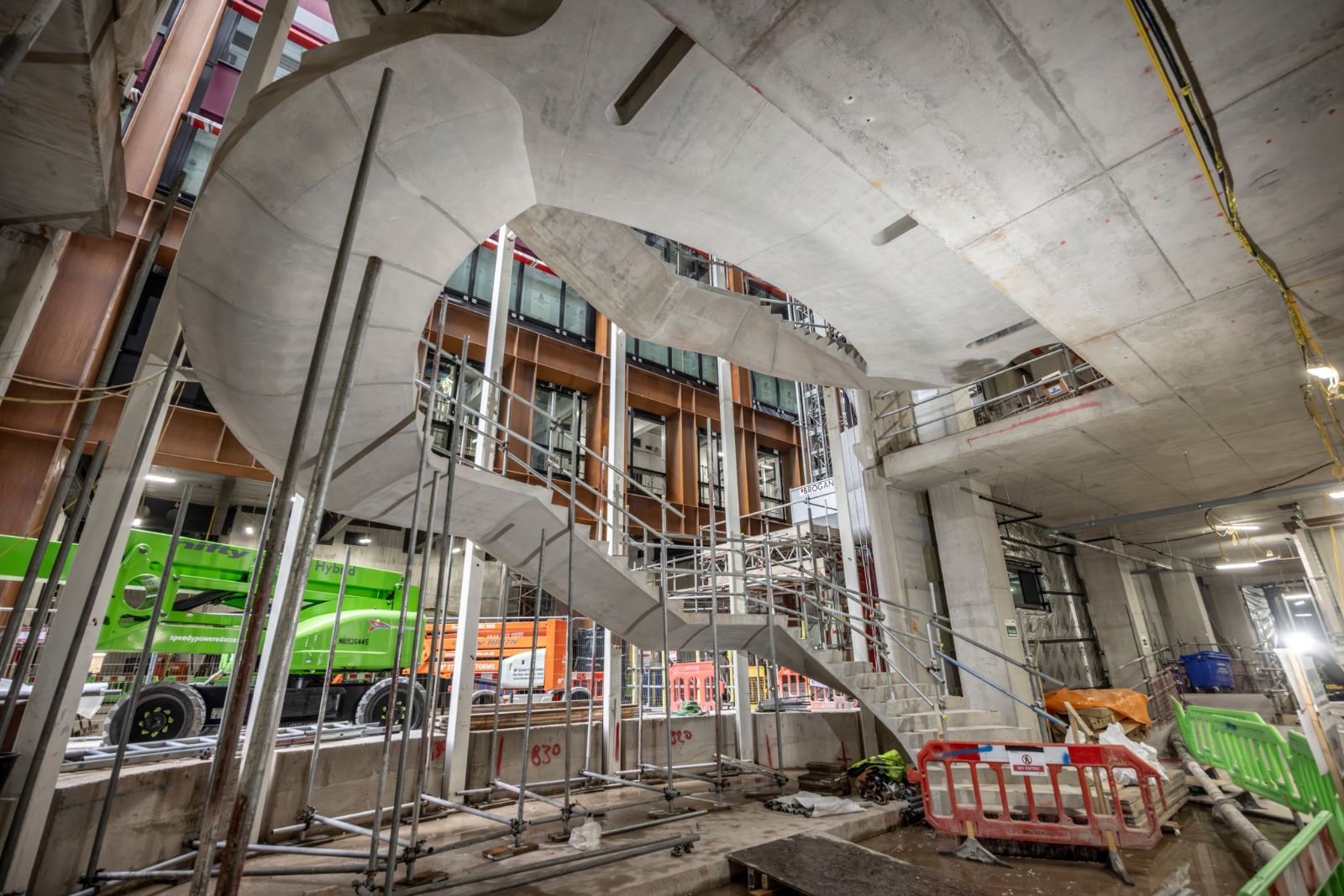
Another view of the helical stair for Salisbury Square development
Spiral and helical staircases lineage, with early examples dating back to 480 BC in Italy. Their use expanded significantly following the construction of Trajan’s Column in ancient Rome, where they became prominent features in temples, basilicas and tombs – typically reserved for high-status structures.
Spiral staircases are constructed around a central spine, whereas contemporary applications increasingly favour open-well helical designs, which omit a central supporting column and incorporate handrails on both sides of the stair treads. These configurations offer more uniform tread depths and can be adapted to circular, elliptical or oval footprints. Beyond aesthetics, helical staircases provide an efficient means of circulating within limited floor space, making them suitable for both functional elements, such as emergency escapes, and creating refined architectural statements.
Despite their elegance, the double-curved soffit geometry remains one of the most challenging aspects to construct using traditional formwork. Historically, carpenters relied on craft-based techniques, assembling faceted plywood or lath strips to create curved casting surfaces. Although capable of producing acceptable flat or sloping soffits, these methods are time consuming and heavily dependent on individual craftsmanship.
Advancements in CAD and CAM software (computer-aided design and manufacture, respectively) now allow designers to translate architectural plans, sections and elevations into accurate 3D representations of stair geometry that can be physically created by specialist companies. These virtual models clarify relationships between treads, risers, finished floor levels and soffit interfaces, while enabling early co-ordination for elements such as balustrades or cast-in fixings. They can also be integrated into BIM environments, helping project teams identify clashes and refine details before construction.
Once approved, the model serves as the basis for manufacturing specialist formwork capable of replicating the full complexity of the stair profile, including planar, sloping, patterned or V-shaped soffits. Designs can be translated directly to CAM machine data, allowing them to be manufactured to the agreed specification. This direct relationship between concept and manufacture allows for far greater creativity at the proposal stage, while simultaneously providing reassurance that the construction will precisely match the design intent.
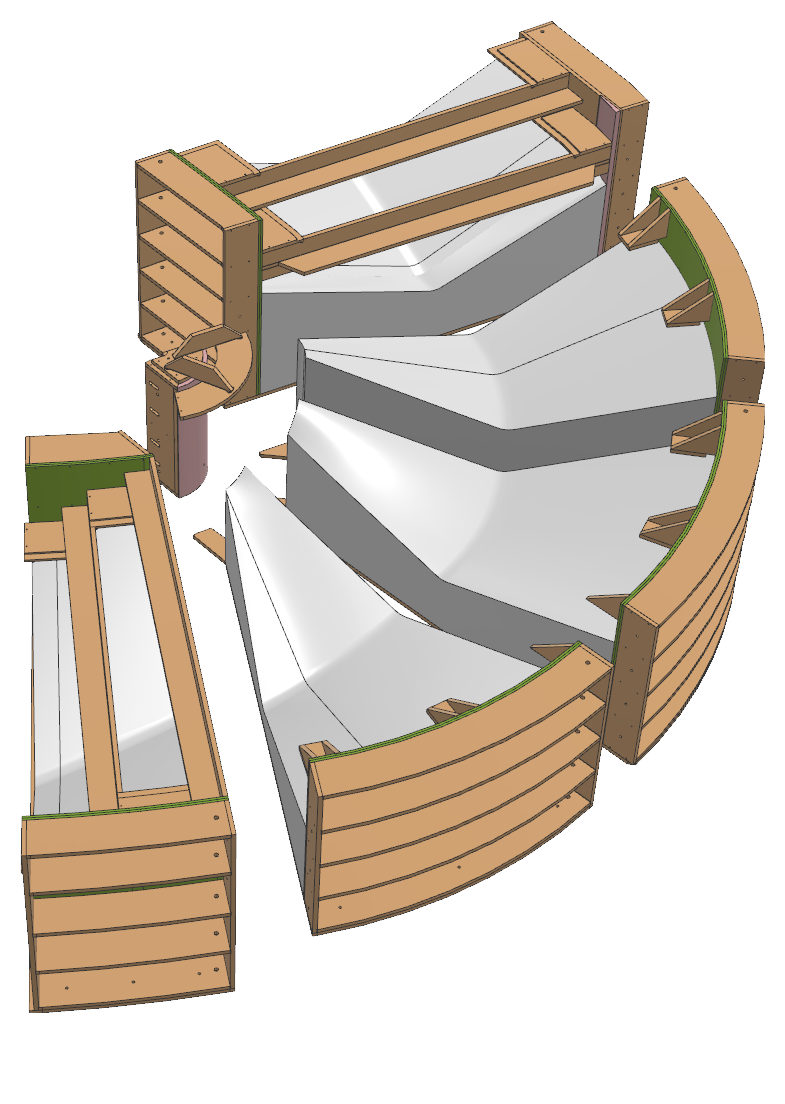
Preassembled sections facilitate site logistics and minimise the install duration. The modular arrangement is designed to ease striking and enable potential reuse
In-situ reinforced concrete staircase formwork typically requires three main elements:
Fabricating in-situ plywood formwork for a double-curving soffit relies heavily on accurate setting out, using architectural drawings for site measurements. The challenge here is that sheet materials, by nature, can be difficult to form into twisting surfaces, so often multiple smaller sheets are required to accurately achieve the desired geometry. This process requires highly skilled operatives to avoid a faceted or patchwork appearance. All joints must then be smoothed and levelled, which can be very time consuming.
A highly effective alternative approach to creating the complex geometry is the use of machined polystyrene soffit formers, coated with a rigid, smooth resin-coated casting surface. Polystyrene is lightweight and can be easily moved into position, while the resin-coated casting face provides a durable surface to form the concrete soffit. This combination of materials ensures dimensional accuracy and predictable finish results, allowing the moulds to strike away from the concrete once cured. Formers can be produced off-site under factory conditions and are machined to precisely match the architectural design.
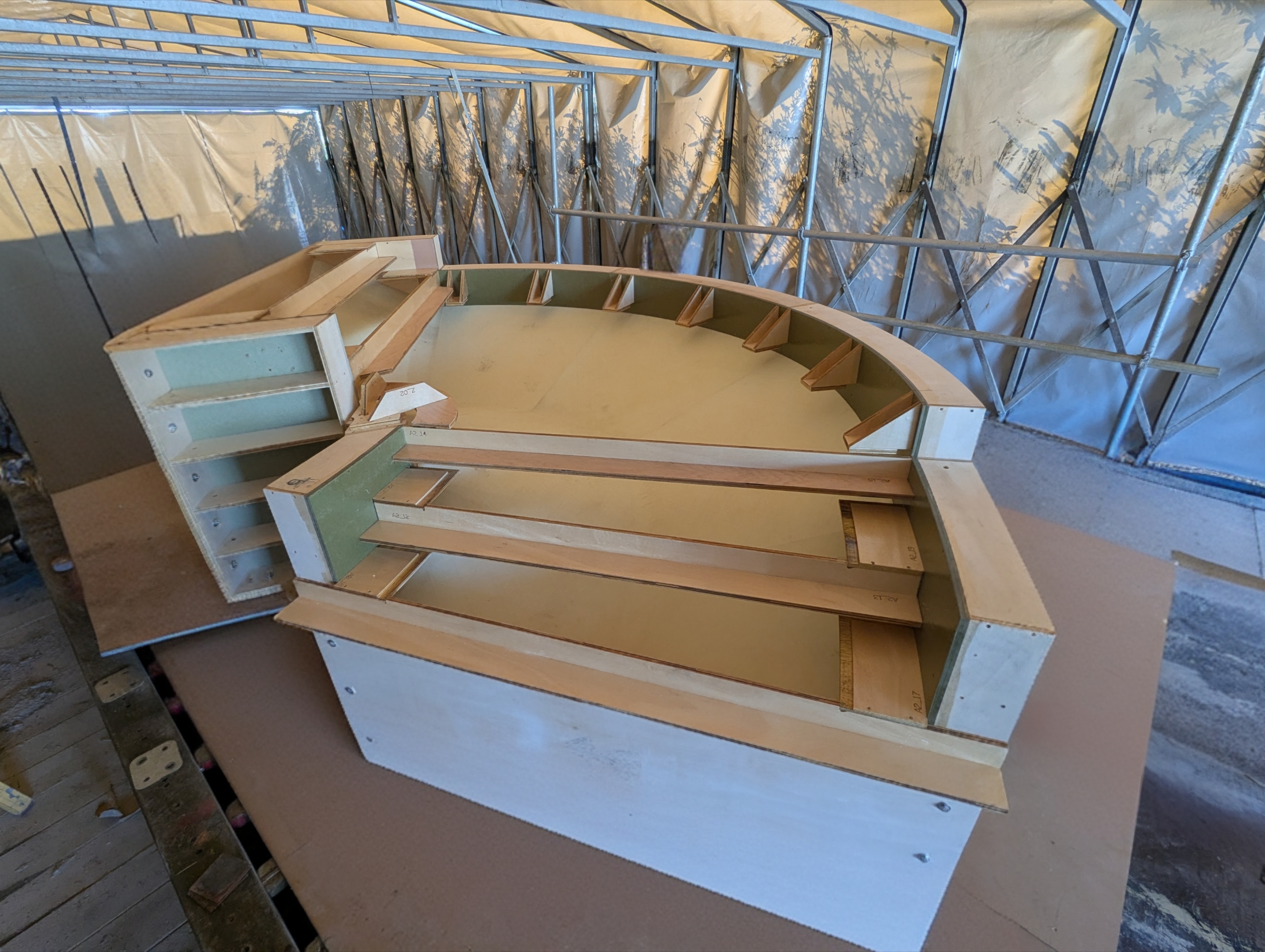
A fully featured section of formwork for a trial mock-up of the Clothworkers’ Hall redevelopment by AJ Morrisroe & Sons comprising double-curved soffit, peripheral shuttering, riser screed rails and location bracketry for cast-in-situ anchors
This accuracy is achieved using five-axis CNC routers, which shape the former to the approved geometry, thereby achieving fine manufacturing tolerances. Multiple blocks are then assembled on-site using falsework decks, stepped appropriately to follow the stair’s rise. Mechanical connectors such as dowels or pins maintain accurate alignment during fixing and pouring, ensuring tight joints between blocks.
Sidewalls can likewise be produced as CNC-machined engineered timber panels that accurately define the stair profile. Locator markers for riser boards can be integrated during fabrication and cast-in features, such as lighting recesses, fixings or decorative inlays, can be positioned with confi dence using the digital model. This removes the need for post-construction cutting or drilling of the concrete, reducing noise, dust and potential clashes with reinforcement.
By prefabricating components in this manner, complete formwork modules can be factory checked, delivered to site and installed efficiently in line with the construction programme.
As with any formwork system, the fabricated shutters will be designed to provide a concrete finish that matches the architectural specification, but they must also be adequately propped to resist pouring pressures. This can be achieved using various proprietary support structures; the design of which can be driven by the federated CAD model, allowing temporary works checks to progress well in advance of construction. Early collaboration between architects, engineers and contractors is critical to optimising the staircase design and ensuring buildability. This team approach de-risks the project deliverables and allows for significant time savings on-site.
When combined with carefully engineered steel reinforcement strategies, non-standard soffit geometries can create stair profiles that appear slender and lightweight, while achieving substantial spans without additional support. This can also lead to a reduction in the volume of concrete required. By using specialist formwork and adopting an interdisciplinary approach during preconstruction, complex elements such as spiral or helical concrete staircases can be delivered with greater accuracy and predictability. This approach can reduce labour-intensive on-site fabrication, streamline programme duration, minimise health and safety risks, and lower overall project costs.
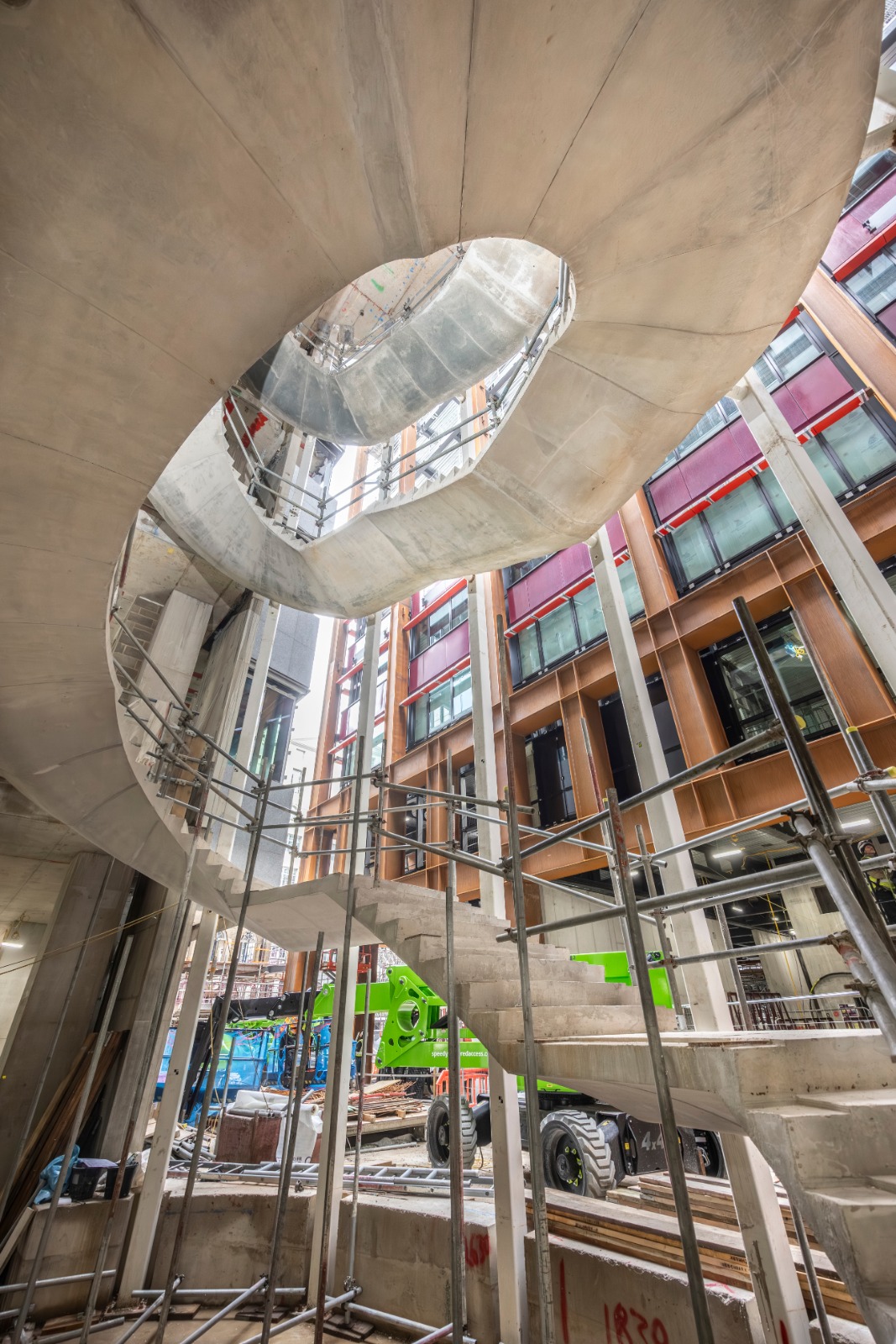
Salisbury Square Development features a large open-well helical staircase, formed by Keltbray, using a modular formwork system from Cordek
 British Plastics Federation